Reviewed for accuracy by A.T., M.A. · Last updated September 29, 2026 · Editorial policy
Find your level of care — therapy, outpatient, IOP, PHP, or residential. La Jolla Recovery.
“Do I need rehab, or just a therapist?” is the wrong first question
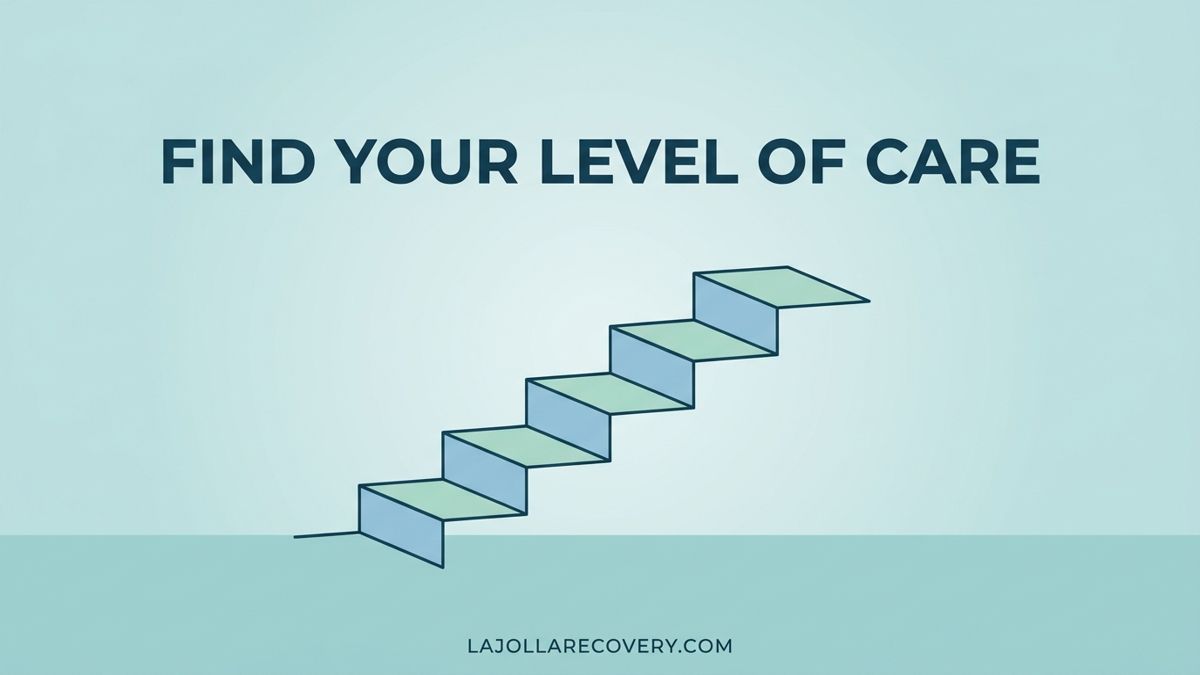
When you finally admit something needs to change, the choices feel binary and terrifying: either weekly therapy, or disappear into a 30-day rehab. But care isn’t two options — it’s a spectrum, and most people land somewhere in the middle. Knowing the levels means you can get help that actually matches your life instead of over- or under-shooting. Here’s the plain-English map.
The levels of care, from lightest to most intensive
Addiction and mental health care is organized into levels of care — a framework formalized by the American Society of Addiction Medicine (ASAM). Think of it as matching the intensity of support to the intensity of what you’re dealing with.
1. Individual therapy / counseling
Weekly (or biweekly) sessions with a therapist. Great for managing anxiety, depression, stress, relationships, or maintaining recovery. It’s the lightest-touch, most flexible option — and for many people, it’s enough.
2. Standard outpatient treatment
A step up from solo therapy: a structured program of a few hours per week, often combining individual and group sessions. You live at home and keep working or going to school. Good when you need more support and accountability than one weekly session.
3. Intensive Outpatient (IOP)
More hours, more often — typically 9–15 hours a week across several days, while still living at home. IOP is a sweet spot for people who need real structure for a substance use or mental health condition but don’t need 24/7 supervision.
4. Partial Hospitalization (PHP)
The most intensive outpatient level — often five to six hours a day, several days a week. You get near-daily clinical support but still sleep at home. Often used as a step down from residential, or a step up when outpatient isn’t enough.
5. Residential / inpatient
You live on-site, with round-the-clock support. This is for situations that need a fully immersive, supervised environment — including medically supervised detox when withdrawal could be dangerous. The most intensive, and not where most people need to start or stay.
So which one is right?
A rough guide: the more your daily functioning is affected, the higher the level of care. If you’re holding down life but struggling internally, therapy or standard outpatient may fit. If substance use or symptoms are disrupting work, relationships, and safety, IOP or PHP gives structure without putting your whole life on pause. Residential is for when home isn’t safe or stable enough to recover in.
Two things worth knowing: care is meant to flex up and down — people commonly step down from PHP to IOP to outpatient as they stabilize. And if a mental health condition and substance use are both in the picture (a dual diagnosis), you want a program that treats them together at whatever level you’re in.
How La Jolla Recovery fits in
La Jolla Recovery specializes in the outpatient side of this spectrum in San Diego — structured, flexible care with a dual diagnosis approach and aftercare for the long game, so you can get meaningful support while staying connected to work, school, and family. Not sure which level you need? That’s normal — reach out through our contact form and we’ll help you figure it out honestly, including pointing you to a higher level of care elsewhere via SAMHSA’s treatment locator if that’s what’s right.
Related Reading
- How can you learn to be more mentally and emotionally fit?
- What to Expect in an Outpatient Program: A 2026 Walkthrough
Frequently asked questions
Do I need rehab or just therapy?
It depends on how much your daily life is affected. If you’re managing day to day but struggling internally, individual therapy or standard outpatient may be enough. If substance use or symptoms are disrupting work, relationships, or safety, a more structured level like intensive outpatient (IOP) or partial hospitalization (PHP) may fit better. Residential care is for when a safe, stable home environment isn’t available.
What’s the difference between IOP and PHP?
Intensive Outpatient (IOP) is typically 9–15 hours of programming per week while you live at home. Partial Hospitalization (PHP) is more intensive — often five to six hours a day, several days a week — but you still sleep at home. PHP is the most intensive outpatient level; IOP is a step below it.
Can I get addiction treatment without going to inpatient rehab?
Yes. Many people recover through outpatient levels of care — standard outpatient, IOP, or PHP — without a residential stay, especially when they have a stable home environment. These options let you keep working or going to school while getting structured support.
What are the levels of care in addiction treatment?
From least to most intensive: individual therapy, standard outpatient, intensive outpatient (IOP), partial hospitalization (PHP), and residential/inpatient (including medically supervised detox). The framework comes from the American Society of Addiction Medicine, and people often step down through the levels as they stabilize.